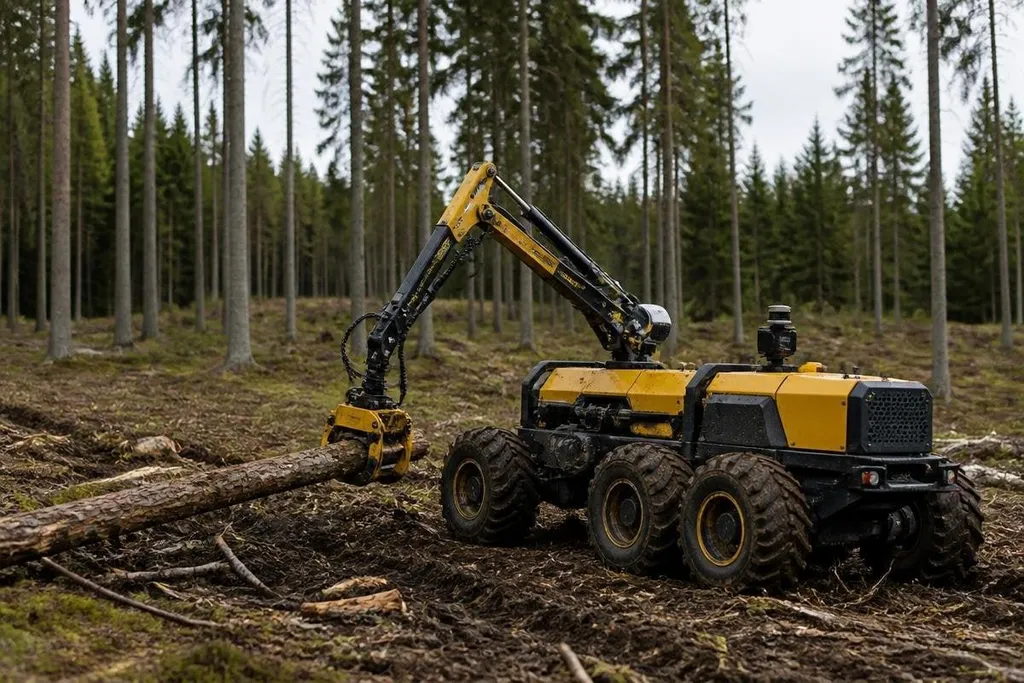
A forest gives robots problems that factory floors avoid: uneven ground, mud, roots, changing light, and trees that block signals. The firms building forestry robots will need to show steady work outside the lab, where a small navigation error can stop a task.
Quick read
- Forest robots need reliable movement, mapping, and object handling.
- A demo matters less than repeatable work across changing ground.
- Buyers should ask for field results, service plans, and a clear role for people.
The work starts with movement
Wheels, tracks, legs, or a mix of these systems change how a forestry robot handles slopes, wet soil, loose stones, and hidden gaps beneath leaves.
LiDAR measures distance with laser pulses, while cameras add colour and shape data. Those inputs can be combined with satellite positioning and an inertial measurement unit, or IMU, which tracks motion and tilt.
That sensor mix only helps if the robot can keep its map useful when branches move, rain dims the cameras, or trees block satellite signals.
A map that works on a clear test route says little about a forest after a storm.
The control software also needs a safe response to failure. If a motor loses grip or a sensor stops reporting, the robot should slow down, stop, or ask a remote operator for help instead of guessing.
The task decides the robot
“Forestry robot” covers several jobs, and each one needs a different machine. A machine carrying tools through a worksite faces a different problem from one checking tree health or moving cut timber.
The useful question is the task: what must the robot carry, touch, cut, inspect, or measure? A gripper that handles a uniform test object may struggle with wet bark, tangled branches, or a load that shifts during travel.
Energy use differs for a robot that spends much of its shift climbing, turning, or waiting for a safe route. That work differs from travel on a flat service road, so buyers need work records, not a single runtime number from a controlled test.
A forestry robot’s result depends on slope, ground cover, tree spacing, and the work left for a crew. Reports from Robot24 can place a claimed route time or payload beside those test details, giving you a firmer way to judge the machine before the next section sets out what counts as proof.
What counts as proof
A credible field report should connect the robot to a named job and a measured result. It should say where the robot ran, what ground it faced, how often a person took control, and what happened when conditions changed.
The report should also separate robot work from human work. A remote operator who guides the machine through every difficult section may still make a useful system, but it isn't the same as independent operation.
Costs matter just as much. The purchase price is only one part of the bill. Charging equipment, transport, software fees, repairs, spare parts, training, and lost work during recovery all affect the case for a machine.
No supplied evidence here names a company, trial, price, or measured result. That limits any claim about who leads the global race. I’d wait for named deployments and repeatable field data before choosing a winner.
A buyer’s field checklist
Use these points before treating a forestry robot as ready for paid work:
- Name the job: write down the task, load, route, and result the robot must produce.
- Test rough ground: include slopes, mud, roots, poor light, and blocked satellite signals.
- Record human input: count remote interventions and note why each one happened.
- Check recovery: confirm how the robot stops, restarts, and gets removed after a fault.
- Price the full system: add batteries, charging, transport, support, repairs, and training.
- Set a pass mark: choose the output and uptime needed before the trial starts.
Passing this check earns a longer trial, not an automatic purchase. Forestry work changes with weather, ground, and season, so the next useful proof will be a dated record that shows how performance holds across those changes.